FAQs
Frequently Asked Questions or “Tuffleye 101”

We, at Wet A Hook TechnologiesLP, suggest that all Tuffleye owners look through this page.

1. What exactly is Tuffleye Core?
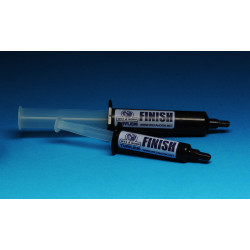
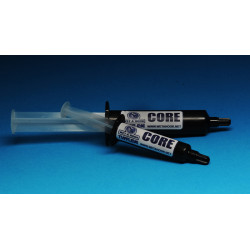
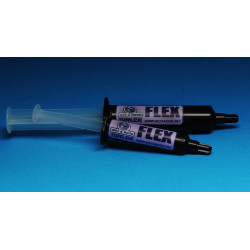
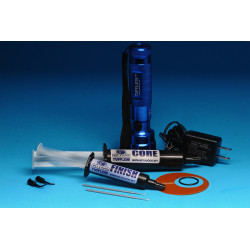
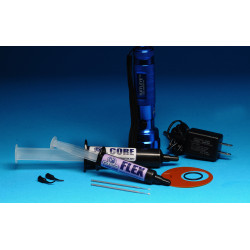
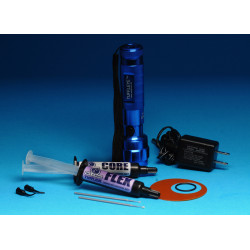
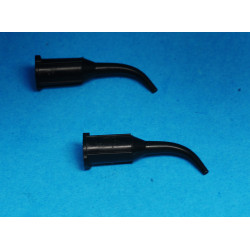
Tuffleye Core is a special acrylic of the safest and highest quality that will cure (set) with a very narrow spectrum of visible blue light. There are three consistencies now (Finish, Core and Flex) and others are being developed. Tuffleye has been formulated to begin curing within 5 seconds and completely harden in 10-20 seconds. It is packaged in light proof syringes. The syringe has a twist off cap that is easily replaced with the provided curved tip applicator if desired. This applicator tip can be trimmed like the tip of a caulking gun to best suit your needs. The syringes are not for re-use.

Mini TipsIMG_0426

2. Will any LED light work with Tuffleye?
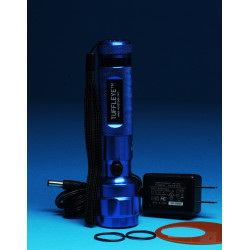
Not likely. The Tuffleye light has been specifically designed to optimally cure this special material. It has a particular spectrum of light and intensity that will not be matched by purchasing a generic LED light. It is nearly identical to what dentists use in both the spectrum of light, and the intensity of the light. Some dentists even have purchased this light to use in their laboratories because it is about one-tenth the cost of their other options.
3. Will regular room lighting cause Tuffleye to harden?
Most room lighting is capable of eventually curing Tuffleye but it is expected to take several hours, or even days, depending on the intensity of your lighting. You should have plenty of working time in regular room lighting. Some halogen desk lamps may be an exception to this. You can always squeeze out a small dot of Tuffleye on a card and time test it under your lighting.
4. Can I use Tuffleye in direct sunlight?
The Sun has almost all spectrums of light in it. There for it will cause Tuffleye to set very rapidly. Within 30-60 seconds you may start to see it curing, or longer, depending on the sun's intensity. You may not get a fast cure and might have to leave it longer.
5. How close should I hold the Tuffleye light to the Tuffleye Core or Finish?
For best curing, the Tuffleye light should be held about 5 mm (one-fourth of an inch) from the material being cured. On large applications you should allow the light to remain for a few seconds on each 5-10 mm section of the material.
6. Will looking into the light hurt your eyes?
If you were using the Ultra Violet (UV) light spectrum the answer would be yes! The “visible” light spectrum is farther away from “X-Rays” than UV. Visible Blue light is a very narrow spectrum that is used safely in dentistry and has been for over 40 years. Nevertheless, we provide an eye shield and recommend that you observe the light curing process by placing the shield between your eyes and the material. Looking into any light for a sustained time is not recommended and we want you to keep your eye sight good to allow you to tie the best flies and lures. The following chart is what is called “The Electromagnetic Spectrum” and allows you to see that UV light is closer to X-Ray Radiation. Eye care and your visual health is why we have not used UV light curing in any of our products.

pastedGraphic

7. How long does it take to cure Tuffleye?
With the proper light, it will begin hardening within 5 seconds and completely harden in 10-20 seconds. If this is not the case there may be a problem with either the light (see FAQ #10) or the photo activator may be expired. Heat will decrease the shelf life of Tuffleye. If Tuffleye does not cure clear you are not getting a complete cure. This can affect the properties of Tuffleye. Please contact us if you encounter any difficulties with this and we will be happy to assist you.
8. If my batteries get low, will it affect the quality of the cure?
Yes, if you use the Tuffleye flashlight powered by batteries only. We suggest changing the batteries after 1-2 hours of use. Effective 26/Mar/2007 we introduced an AC/DC light with a warning sensor to indicate low intensity that may affect the cure.
9. Why do you now only sell one LED Curing Light?
We now provide one exceptional and very versatile light. It contains a high intensity and high quality LED rated to last between 75,000 - 100,000 hours. This light will cure the "Tuffleye" material completely in about 10-20 seconds and has been developed specifically for this purpose. It is capable of running on either 3AAA batteries or the AC current with the adaptor included. The AC adaptor is able to self adjust an electric current from either 120 or 240 volts. Making International tiers happy. We have also added micro circuitry that will notify the user of the intensity of the DC current. When there is not enough battery power to adequately cure the Tuffleye material, a red light will appear. This will notify you to either place fresh batteries or move to an AC power source. The DC only light requires that you self access when your battery power gets too low for proper curing. If you have a DC only light, placing fresh rechargeable batteries at the beginning of each tying session has shown excellent results.
10. Is it possible to tell if my light is bright enough to work correctly?
The only sure way is with a light meter. Each light is checked before shipping to assure its intensity level for curing. If you have a genuine question about the light, you can take it to your dentist and ask him if he will check it with his light meter. It should give a reading of above 200 mw/cm2. (A reading all dentists should be familiar with) Don't be surprised if he wants to know where you got it and how much it costs.
11. Will Tuffleye yellow over time like epoxy?
No. Tuffleye will not yellow even if left in the sun for months. In fact, if you have not completely cured the Tuffleye, it may have a slight yellow cast that will get more clear as it ages in light. When testing Tuffleye Bob Popovics placed a Surf Candy on the dashboard of his car for months with absolutely no yellowing.
12. What is the tacky outer layer on the Core?
Core’s tacky outer layer is a chemical reaction to air (Oxygen). All light cured acrylics have it and it has pros and cons. The pro is that you may add eyes, overlays, wings, legs, etc., to your fly and Tuffleye will not only act to help stick them in place, but an additional covering of Tuffleye will irreversibly bond to itself. The con is that once the fly is tied, many tiers desire to eliminate the tacky surface.
13. How can I get rid of Tuffleye’s tacky outer layer?
There are several ways. (Refer to our "Hot Tips" page for more info on this.) "Tuffleye Finish" can be painted as a thin coating over Cores tacky layer and cured. Merely polish the oily residue off Finish and you’ll have a glossy coat. Although it is a bit more difficult, you can also wipe the tacky surface off the Tuffleye Core. You can also use rubbing alcohol. Rubbing this surface with a rag or your finger can also restore the glossy finish. Tuffleye Core is the most durable of all our products surfaces. If the final surface is more dull than wanted (In the water, a frosted finish is not visible.) For show or shadow boxes, many of our testers will paint on a thin coat of Hard as Nails or Hard as Hull after removing the tacky layer. The following photos show the Tuffleye frosted surface on the left that comes after being wiped with Rubbing Alcohol. The side on the right is a thin coating of Hard as Nails and the bubble is a tiny droplet of water.

DSC_0501 DSC_0515
14. Is Tuffleye Core as durable as UV acrylic resins or epoxy?
Tuffleye Core is as strong or stronger than most epoxies. It is made of an extremely high quality acrylic. While most UV based acrylics available will bend, tear, shrink, or break under normal hand strength, Tuffleye Core will not bend, tear or break under that same pressure. The base ingredient of Tuffleye Core is one of, if not the most, biologically and ecologically safe, light cured, materials man has. Epoxies and other UV cured acrylics that we have evaluated cannot make this claim. If you have any questions about our commitment to you and our environment, please call, mail, or email us. We believe in personal service and you can talk with a real person at Wet A Hook Technologies.
15. Can I use Tuffleye Finish as one application and skip using Tuffleye Core altogether?
Yes. For smaller flies or applications, Tuffleye Finish will work superbly. Tuffleye Finish is a bit more flexible and flowable than Core. Our testers have used Finish for all kinds of applications. It is excellent for head cement, attaching body parts, etc. However, it is not as durable alone for forming larger flies and we recommend Core if your desire is the most durable, longest lasting fly.
16. How should the Tuffleye syringes be stored when not being used?
Remember, the same cap you had to unscrew to get to the Tuffleye, you can place back on the tip of the syringe, or if stored out of the light you can simply pull back slightly on the syringe till you see the Tuffleye material retreat back into the curved tip then store it away form any light. While using Tuffleye, the light proof syringes will protect it from normal room lighting. We suggest when not using Tuffleye, you keep the syringes stored in a light proof container. Tuffleye is easy to store if kept in a cool light proof place.
17. Is there a shelf life for Tuffleye Core and Tuffleye Finish?
Yes, after 12 to 18 months, Tuffleye could begin to be more difficult to cure as the photo initiators begin to age. By refrigeration, when not being used for long periods of time, you can extend the shelf life substantially. Be sure to warm Tuffleye up a bit if bringing it out of refrigeration since Tuffleye is very thick if cold and flows more the warmer it gets.
18. Why do I get a yellow or rust colored tint after applying Hard as Nails over the surface of my Tuffleye?
There is a chemical preservative in some of the nail polishes or surface coatings that will react with the surface of Tuffleye depending on the type (some do and some don’t) used. We suggest you try the type of coating you have on a small piece of cured Tuffleye before using that surface coating on your Tuffleye flies. (This can also happen to other fly tying materials you may be using.) The photo below shows what we have found with one of the nail polishes tested. The side on the left is coated with Sally Hansens “No Chip” brand. The yellowish color (chemical reaction) has turned even darker as it has been exposed to the sun. The clear side has no coating added.
DSC_0138
If you have any other questions please email (Contact us), phone (1-250-544-8128), or mail (7272 Wurzbach Rd. #404, San Antonio, Texas 78240), us. We try our best to give you exceptional service. You can talk with a real person at Wet A Hook TechnologiesLP. (We can even use “Skype” to communicate through real time video. Live Tuffleye tying demonstrations can also be scheduled.) If not immediately available, we will get back to you as soon as possible. Thank-you!